
There wasn’t a permanent “Issa Somali village” in New York in 1914, but a distinct group of over 60 Issa Somalis arrived at Ellis Island in March 1914, brought for exhibition. Ciise Sitti oo bandhig Carweed dhaqana geeyaay New York bishii saddexaad 1914 kii. Part I.
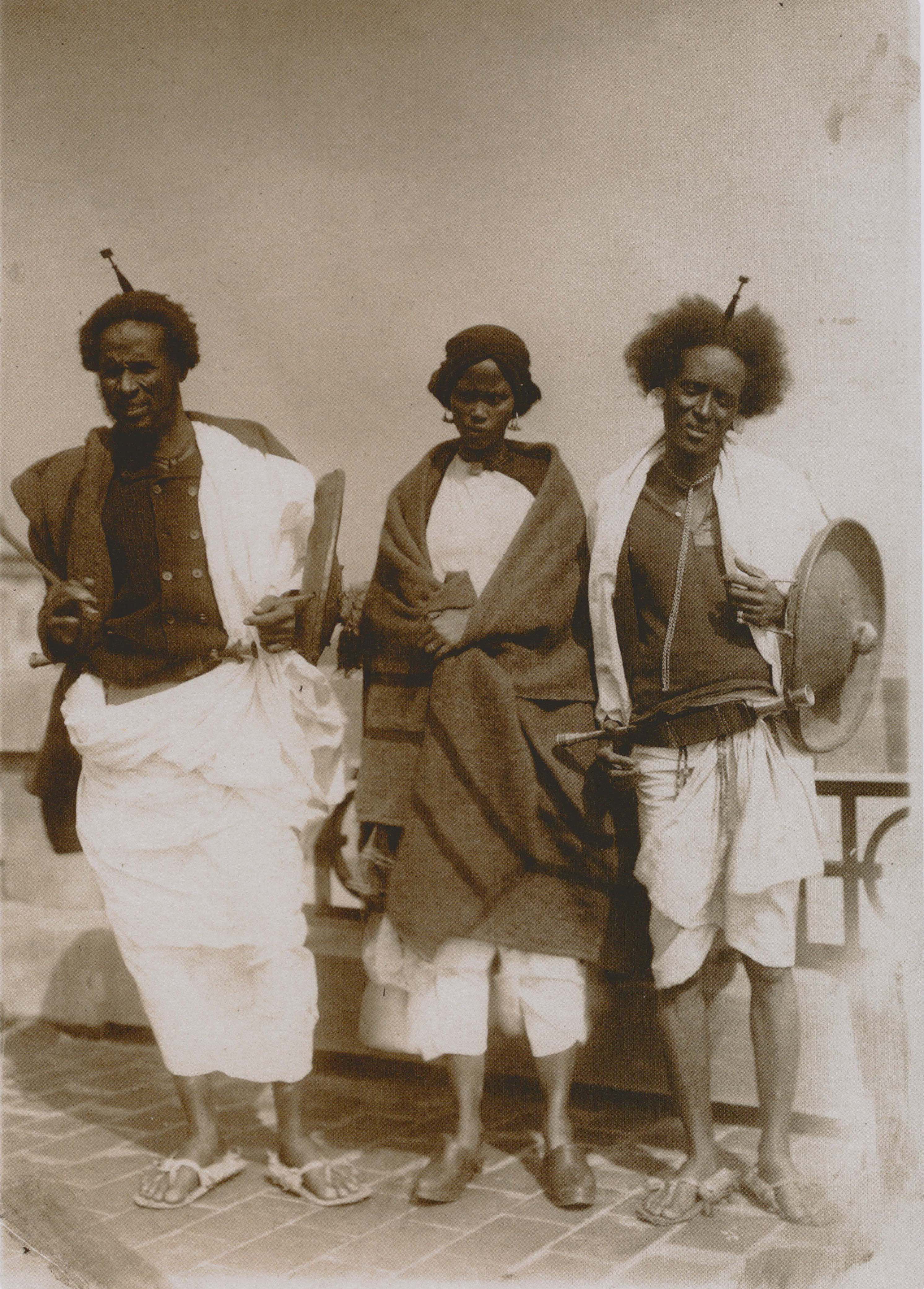
On a cold morning, 14 March 1914, the inspectors at Ellis Island New York entered an unusual notation into their daily logbook. More than sixty travelers from Northeast Africa had arrived aboard the S.S. Chicago from Le Havre. Their garments, bearing, and collective presence were unlike anything the immigration officers had encountered that week. The curiosity was great enough that Augustus Sherman, Ellis Island’s unofficial portraitist, assembled them for a series of photographs, images that would later achieve iconic status despite remaining strangely anonymous for over a century.
In truth, attracting attention was precisely the reason these men, women, and children had come to the United States. New York, San Francisco, Chicago, and these were their planned stages. But they were not immigrants seeking settlement, nor tourists sampling a foreign land. Legally, they were “non-immigrant aliens,” brought across the Atlantic to embody an exoticized idea of Africanness for eager American audiences. They were performers.
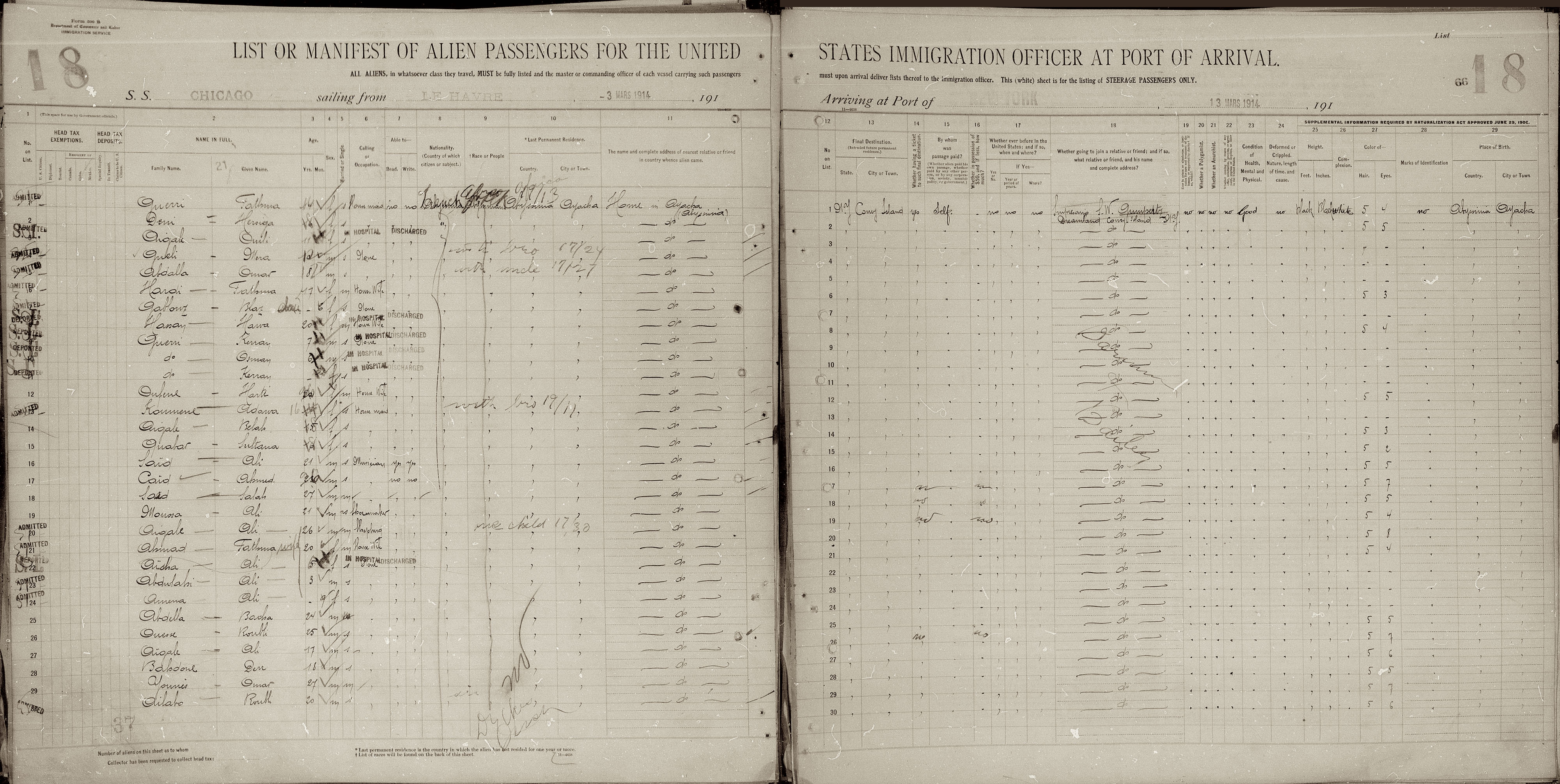
For more than one hundred years, the identity of this unusual group remained obscure. Sherman’s photographs, lacking captions or dates, were long considered enigmatic portraits of unspecified “Africans.” But by cross-examining the ship’s manifest, immigration transcripts, scattered newspaper accounts, and visual clues hidden within Sherman’s images, a fuller and darker story emerges. These people were not Borana from southern Ethiopia, as previously assumed. They were overwhelmingly Issa Somalis from the region then known as French Somaliland—today the borderlands of Djibouti and eastern Ethiopia.

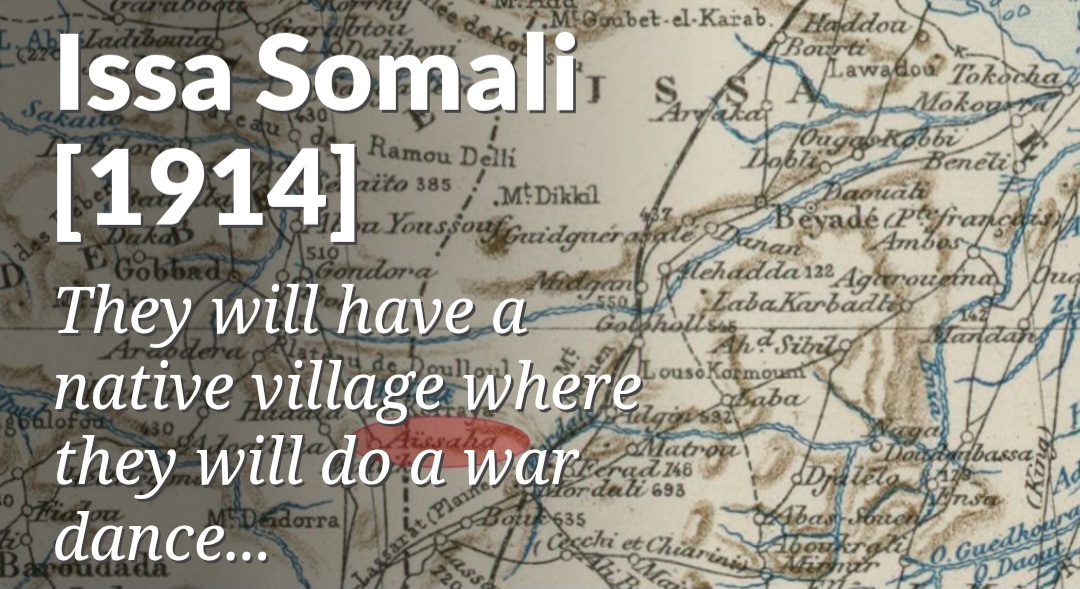
The ship’s manifest listed their point of origin as “Aysha/ayshaca, Abyssinia”, a transliteration of Aysha/Aïssaha, an Issa Somali village situated along the Franco-Ethiopian frontier. The “nationality” column identified them as French colonial subjects, further confirming that they hailed from French Somaliland, not independent Ethiopia. Their homeland, at the dawn of the First World War, was a place riven by imperial ambition: Italy on the Red Sea, Britain in Aden and Somaliland, and France entrenched around Djibouti, carving out spheres of influence through force, treaties, and coercion.

These Somalis arrived in America not as citizens of a sovereign nation but as people already captured within the machinery of empire. And this machinery had one more task for them.
Human Exhibits for a Western Spectacle
Throughout the late 19th and early 20th centuries, Europe and the United States were obsessed with ethnological exhibitions, what we now call human zoos. Visitors paid to gaze upon Indigenous peoples staged in artificial “villages,” crafted to showcase their supposed primitiveness or savagery. From Paris to Hamburg, Vienna to Turin, Somali “villages” had been popular attractions for decades. Picture postcards, museum displays, and fairground broadsides portrayed Somalis as warriors, camel herders, spear fighters were always exotic.
The U.S. had its own versions. P.T. Barnum’s circuses and the Ringling empire filled tents, theaters, and amusement parks with spectacles ranging from demeaning to grotesque. Coney Island’s Dreamland and Luna Park maintained permanent sideshows featuring staged “villages” of foreign peoples.

Into this world the Issa Somalis stepped.
According to the ship manifest, the group was contracted to appear at Dreamland, under impresario Samuel W. Gumpertz. Immigration records also reveal an endorsement from Frank A. Cook, a key figure in Barnum & Bailey’s international performer recruitment network. Gumpertz and Ringling, fresh from a talent-scouting expedition in Europe, announced that Dreamland’s 1914 season would feature a spectacular “Somaliland Village,” complete with Somali teachers, doctors, and the recreation of “native” life for the American gaze.

The Issa Somalis were slated to be the centerpiece.
Ellis Island: Detention, Display, and the Camera’s Gaze Before their performances began, several members were detained, and some hospitalized, others summoned before a Board of Special Inquiry. Their fate hung in bureaucratic limbo, a situation that allowed Sherman to photograph them repeatedly. The resulting portraits, now scattered across archives, show quiet dignity in the midst of profound vulnerability.
Most of the travelers were under the age of thirty-five. Their listed occupations were pastoral: shepherds, camel drivers, blacksmiths, musicians. They were people whose livelihoods had been rooted in the land, thrust thousands of miles away into a world where their identity became a staged spectacle.
Their names were: Abdalla, Asha, Bahdon, Ogle, Saïd, Mohamed, speak clearly of Somali lineage and Islamic heritage. Even so, the authorities struggled to classify them beyond racial caricature. One newspaper sneered that Ellis Island officers were unsure whether they were “Arabians, Egyptians.’”

Within seven days of arrival, they were already on display
On 21 March 1914, the New York Clipper reported that Madison Square Garden’s season opener featured the “Somali Village for Sixty natives of Somali Land” alongside midgets, giants, “Maxine the snake enchantress,” and the “lion-faced boy.” The Issa Somalis, marketed under the sensational title “Somaliland”, were absorbed seamlessly into the American economy of exotica.

From Coney Island to the Circus Road
The Issa Somalis’ American journey followed a path well worn by other human exhibits. After performing at Dreamland and Madison Square Garden, they traveled across the United States with Barnum & Bailey, then returned to Coney Island for summer shows. Their routines mirrored those performed in Europe: mock battles, spear dances, “war cries,” staged domestic life, and all framed through a colonial lens of primitivism.
But as summer faded, so did their fortunes.The Panama–Pacific Exposition: Promise, Betrayal, and CollapseIn late 1914, about half the group chose to continue performing, accepting a 10-month contract for the 1915 Panama–Pacific International Exposition in San Francisco. There, they were again advertised in sensational, racially charged terms: “cannibal head hunters,” “war dancers,” “spear fighters.”Within two months, their wages went unpaid. When they refused to continue performing without compensation, exposition officials canceled their contract, seized their encampment, and forcibly removed the entire group. They were detained at Angel Island Immigration Station, unpaid for their labor and replaced by another attraction.

Resources University of Southern California

Zeila Heritage waa madal kayd iyo dhaqan-dhawr ah oo u heellan ilaalinta, ururinta, iyo faafinta taariikhda, dhaqanka, iyo xusuusta guud ee beesha Ciise iyo deegaanadeeda. Waxyaabaha lagu soo bandhigo waxay ku dhisan yihiin warbixinno afeed, xusuus-dhaqameed, xeer dhaqameed iyo qoraallo taariikheed oo la keydiyey si jiilalka mustaqbalka loogu gudbiyo.